Slavery by Peter J. Parish
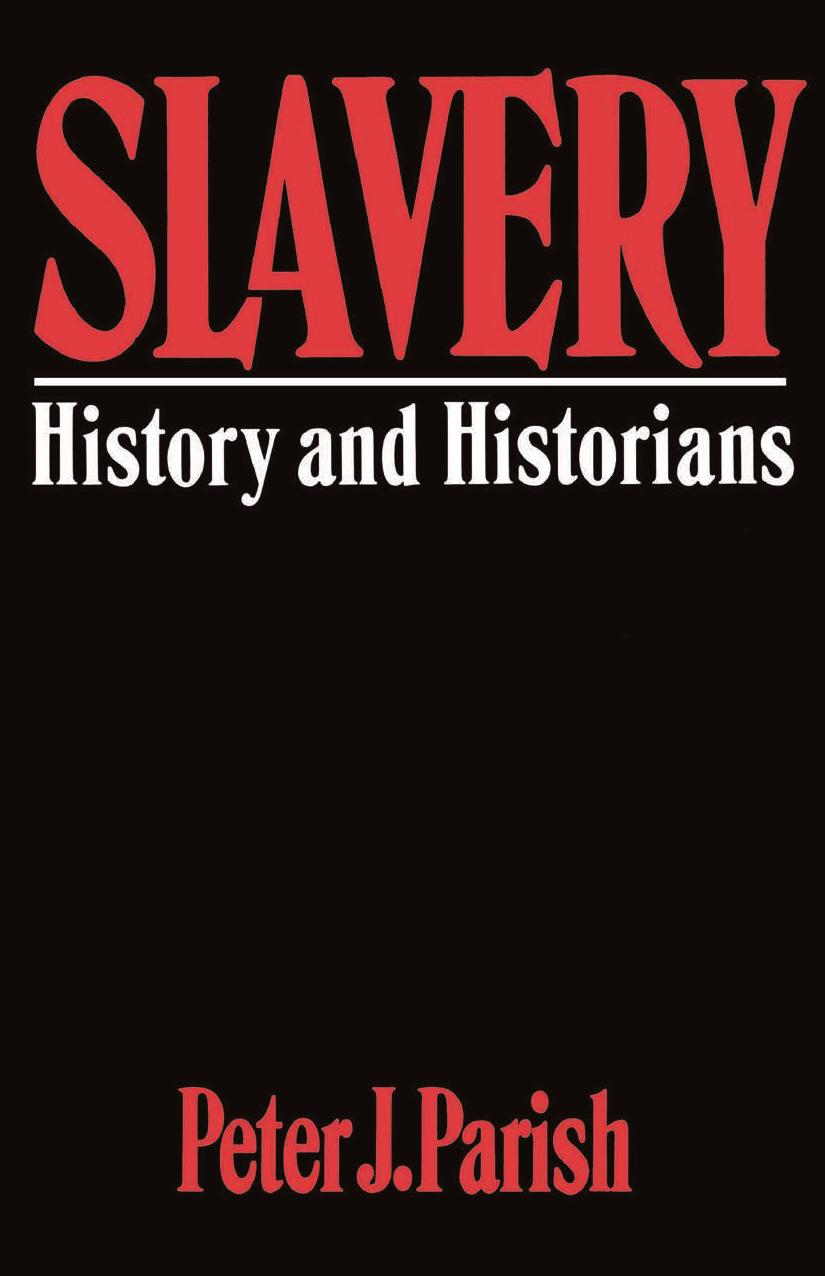
Author:Peter J. Parish
Language: eng
Format: epub, pdf
Publisher: Taylor & Francis (CAM)
6
Variations, Exceptions, and Comparisons
Any brief survey of the slave system is almost bound to convey a spurious impression of uniformity, at odds with the untidy historical reality. The balance may be restored a little by a reminder of some of the variants and the exceptionsâthe edges of slaveryâwhere its dividing lines, so often very sharp and clear, become blurred and uncertain. There is a more positive reason, too, for devoting attention to these areas of the slave system. Much of the character of an institution may be revealed by its margins and its abnormalities. Exceptions may not prove rules but they can put them into clearer perspective. Inevitably, the key books which have transformed the history of slavery during the last generation have been comprehensive, panoramic, or synoptic in their approach. In attempting to treat the subject at large, Stampp, Elkins, Blassingame, Genovese, Fogel and Engerman, and several others, all tend to flatten out differences and variations (whether of time or space, or social context or individual personality) and to pay inadequate attention to slavery in its more unusual forms.
At the same time, there have been excellent studies of particular aspects of slavery. It may be helpful to examine briefly four examples from the exceptions to the rule, the edges of Southern slavery: slaves in the towns and cities, slaves in industry, slaves hired out to employers other than their owner, and the free blacks living in slave states. Each of these four groups represented only a very small minority of the total black population of the South in the antebellum decadesâseldom if ever more than 5 percentâand there was some overlap between one group and another. Nevertheless, the history of these deviants from the pattern of Southern slave society raises important questions about the clear lines of division and the rigid structure normally associated with Southern slavery, about the nature of the master-slave relationship, about the economics of slavery, and about the conventional picture of an agrarian society at the apex of which stood an elite of slave-owning planters.
Many of these concerns can be subsumed into one basic question: Were the exceptions to the norms of the slave South signs of flexibility, adaptability, and potential for growth and developmentâor at least useful safety valves for a tension-ridden societyâor did they constitute a series of threats to both the efficiency and the stability of the system? In other words, were they a sign of weakness or a source of strength? On one hand, the city, the factory or mine, the system of slave hire, and the free black community appeared to threaten the safeguards, if not indeed the foundations, of die Southern slave system. On the other hand, these same exceptions to the general rule could be interpreted as offering the promise of a healthy and prosperous future for the South, whether through a more balanced and diversified economy within the national framework of the United States or through greater self-sufficiency and adaptability in an independent South. At the edges
Download
This site does not store any files on its server. We only index and link to content provided by other sites. Please contact the content providers to delete copyright contents if any and email us, we'll remove relevant links or contents immediately.
| Anthropology | Archaeology |
| Philosophy | Politics & Government |
| Social Sciences | Sociology |
| Women's Studies |
Cecilia; Or, Memoirs of an Heiress — Volume 1 by Fanny Burney(32558)
The Great Music City by Andrea Baker(32019)
Cecilia; Or, Memoirs of an Heiress — Volume 2 by Fanny Burney(31956)
Cecilia; Or, Memoirs of an Heiress — Volume 3 by Fanny Burney(31942)
We're Going to Need More Wine by Gabrielle Union(19046)
All the Missing Girls by Megan Miranda(16029)
Pimp by Iceberg Slim(14508)
For the Love of Europe by Rick Steves(14121)
Bombshells: Glamour Girls of a Lifetime by Sullivan Steve(14076)
Talking to Strangers by Malcolm Gladwell(13370)
Norse Mythology by Gaiman Neil(13365)
Fifty Shades Freed by E L James(13241)
Mindhunter: Inside the FBI's Elite Serial Crime Unit by John E. Douglas & Mark Olshaker(9343)
Crazy Rich Asians by Kevin Kwan(9292)
The Lost Art of Listening by Michael P. Nichols(7506)
Enlightenment Now: The Case for Reason, Science, Humanism, and Progress by Steven Pinker(7314)
The Four Agreements by Don Miguel Ruiz(6765)
Bad Blood by John Carreyrou(6622)
Weapons of Math Destruction by Cathy O'Neil(6281)
